Kaypro and the Legend of the Disk Eater
Last time, we talked about Osborne getting rekt by the Kaypro II. Today, let's take a closer look at the rest of Kaypro's offerings and backstory, as well as their rather infamous non-portable machine...
EDUCATION
YOURSELF
Episode 007
Part 1: The Inventor Rises
Our story begins in 1952, when Andrew Kay founded his company Non-Linear Systems, then invented the digital voltmeter 2 years later. As a result, he made a name for himself producing quality test equipment for electrical engineers. But was that enough? No, of course not. In 1981 he wanted to go after Osborne, and began working on his own computer, the KayComp. This design was based on a kit computer called the Ferguson Big Board, and had a design that was very close to that of the Osborne 1's, namely with the centered screen.
However, Xerox had an exclusive license for re-selling the Big Board, which was used in its Xerox 820 Information Processor lineup. Also, someone else had already trademarked the name "KayComp", and Andrew didn't even own the rights to redistribute a BIOS! Through the "Ship of Theseus" process, every offending element was replaced with something original that could be sold. Eventually, in 1982, a daughter company was formed called Kaypro Corporation and released the Kaypro II, a finalized design that didn't completely ape the Osborne 1.
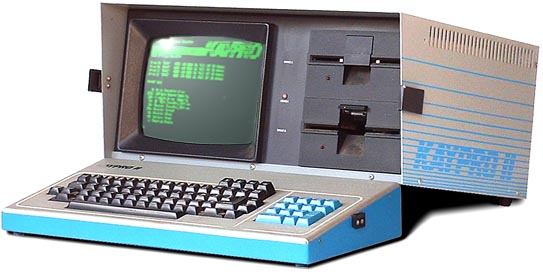
As a quick refresher, this was named as a subtle jab at the Osborne 1, and did pretty much everything the Osborne Executive was going to do. Despite the slower 2.5MHz Z80 CPU and sticking to 64KB RAM, it featured the same pair of 5.25" single-sided dual-density floppy drives, featured a 9" CRT with 80x24 text display, was lighter at 26 pounds (despite an all-metal case!), and did it all even cheaper than the Osborne 1 at $1595. And yes, Kaypro did work with software publishers to bundle software with the computer itself.
Because people were hungry for the Executive, it sold incredibly well, despite people being put off by its design - PC Magazine at the time said that Kaypro was "producing computers packaged in tin cans." Though the real downside was the lack of ability to properly modify or upgrade the computers. Sure the integrated circuits were all socketed, but everything was already at its maximum possible state. There were only two I/O connections, no extra ROM sockets, no expansion bus, no peripheral bus, not even a way to connect to the system bus! There was also no video out connection, so unlike the Osborne 1 you were limited to the built-in display. This turned away the hackers and more technically-minded, but it still attracted a user base due to being more consumer-friendly.
Part 2: Expanding The Range
Now it would be incredibly silly for Andrew Kay to do to himself what Osborne had self-inflicted, so plans were made to quickly expand the product range and avoid being dependent on a singular model. 1983 saw the release of the Kaypro IV, which replaced the floppy drives with double-sided dual-density units, as well as add in WordStar to the bundle of pre-packed software. There were also the Kaypro 5 and 10, which were versions of the II and IV (respectively) that also featured a built-in 10MB hard drive, but only the Kaypro 10 made it to the market.
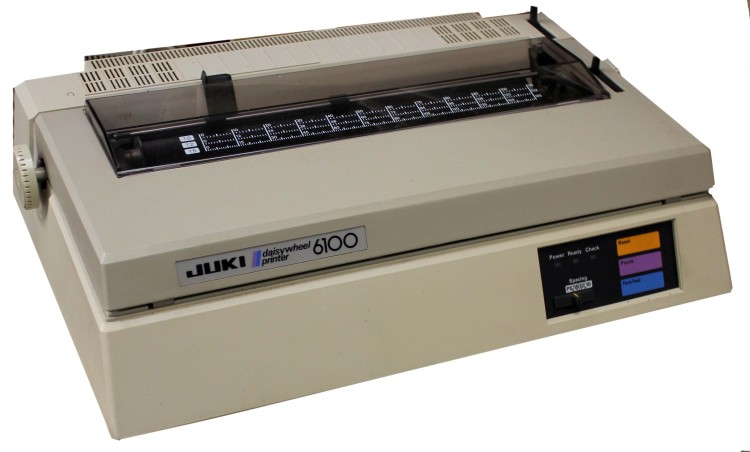
1984 saw a product refresh, replacing the Kaypro IV with the Kaypro 4 (yeah, not at all confusing), which increased the processor speed to 4MHz and switched to half-height floppy drives. It also added some rudimentary graphical capabilities, and added a built-in 300 baud modem. The Kaypro II was replaced with the Kaypro 2X, which was a cut-down Kaypro 4 that lacked its built-in modem, but instead came bundled with a printer! The printer (shown below) was a Juki 6100 daisywheel printer, rebadged as the creatively-named "Kaypro Printer".
There was one other product that came out at this time, and hoo boy, it's time for the machine I eluded to at the start!
Part 3: Darth Vader's Disk-Eating Lunchbox
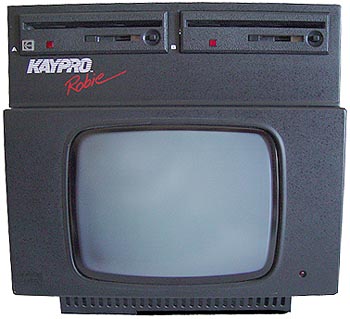
I'm not kidding, this thing was allegedly nicknamed "Darth Vader's Lunchbox". Released in March of 1984, the Kaypro Robie is the only non-portable CP/M machine to come out of Kaypro. Internally, it is effectively the same thing as the Kaypro 4, including the built-in 300 baud modem. The selling point was actually the twin floppy drives, positioned unusually atop the display. These are special drives developed by Drivetec, which was created by Herb Thompson, former founder of Shugart Associates and creator of the first floppy disk back at IBM in 1967! These drives, the Drivetec 320 Superminifloppy, managed to get a whopping 2.6MB on a single 5.25" floppy disk! And the Robie has two of them!
The Robie was discontinued 4 months later because of these drives. So, what exactly happened?
The first problem is the extra complexity of these drives made getting new disks very expensive. The trick used here is that there are two stepper motors controlling the drive head, one for larger "coarse" movements and one for tiny "fine" movements. Half a track above and below each data track is a "BURST" track, which is used for head alignment. If both signals are the same, then the head is aligned. Otherwise, the "fine" stepper uses this data to realign the head with the data track. This mechanism is needed due to how thin and dense the data tracks are, which is how so much data can be crammed onto a single disk. The problem is that these "BURST" tracks can only be written to the disk at the factory. It is impossible to use the drives themselves to format any other 5.25" disk to work with this drive. And the correct disks were far more expensive than regular disks, costing upwards of $16/disk compared to $3/disk for regular ones. On top of this, these drives could only read other 5.25" disks, but not write to them, so even if you didn't care about using the "super"-sized disks, you had no choice.
And that leads to the second problem, where the drives literally ate the disks. This was eventually found to be caused by part of the manufacturing process - in particular, the polishing of the drive heads. The heads were polished using diamond-based tooling, which inadvertently contaminated the heads with very fine diamond dust. And since the heads were never decontaminated after this step, this left them with literal diamond teeth. The mechanism used by the drive head pinched the disk more tightly than conventional drives, which allowed the diamonds to just scrape the magnetic media off the substrate, resulting in very expensive but totally useless plastic circles.
With that second issue, Kaypro found it to be cheaper to just scrap the Robie and push the Kaypro 4 in its place. Though, Bruce Willis got to use one on the ABC television series Moonlighting, so it got some time to shine in the limelight.
Part 4: IBM's Here To Ruin Everything
We're now in 1985, and people are rapidly losing interest in the CP/M ecosystem in favor of IBM's offerings based around Intel's newest CPUs. Kaypro formally announced that they would not stop supporting the CP/M ecosystem for as long as humanly possible, but they also did not hesitate to start migrating their product lines to the New Shiny. Notably, this was started with the Kaypro 4+88, an updated take on the Kaypro 4 that pre-installed a third party modification: the PLUS 88 board from SWP Microcomputer Products. This mod turns the Kaypro 4 into a dual CPU system that can run both CP/M on the usual Z80 CPU, but also run MS-DOS on an 8088 CPU with its own 256KB RAM! This was only $400 more than a regular Kaypro 4, so it was a very nice option.
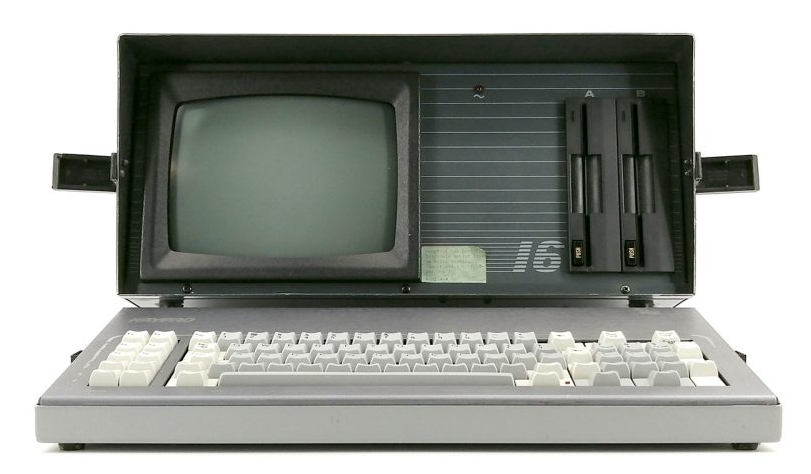
This was quickly followed with actual IBM PC-compatible products, namely the Kaypro 16. It is very similar to the Kaypro 10, but the guts were replaced with an 8088 CPU, 256KB RAM, and came with MS-DOS. It was actually upgradable, and a special bundle edition made for a college, the Kaypro 16/2e, upgraded the RAM to 768KB! This system was very upgradable in comparison to other Kaypro luggables, as it featured actual ISA slots for expansion boards, though most of them were pre-populated on a standard configuration.
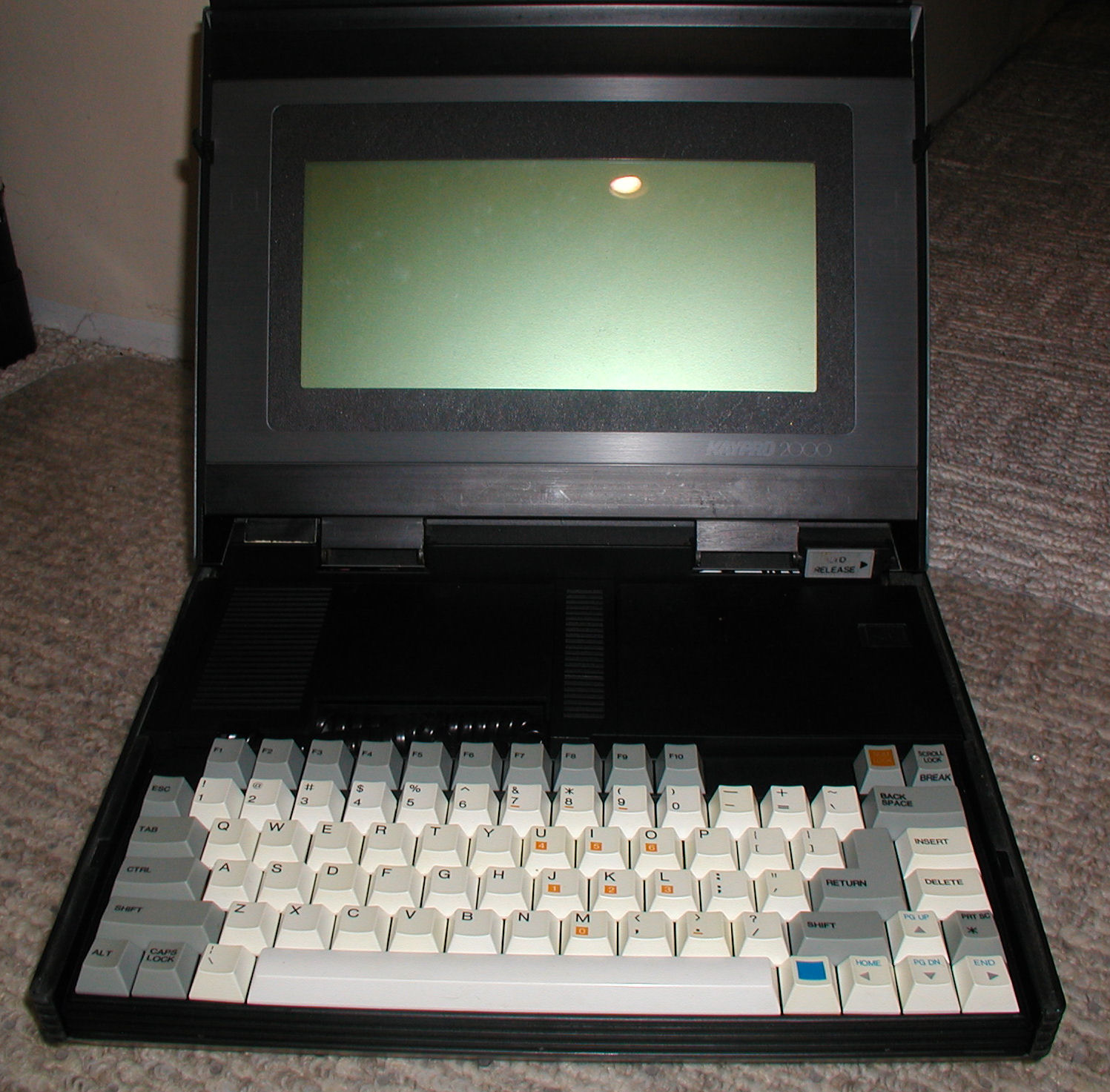
They also tried making a proper laptop design! The Kaypro 2000 featured a detachable keyboard and a pair of 3.5" floppy drives that pop up and out of the system. The case was made out of aluminum by a company in Japan and was not cheap. It also used lead-acid batteries for power, making it stupidly heavy. It was one of the first computers to feature a LCD screen, but there was no backlight and the contrast was pretty rubbish. It could be upgraded to 768KB RAM, and paired with a docking station to add a hard drive and expansion card slots.
As for desktop systems, Kaypro was late to offering a PC clone of their own, but they did deliver the Kaypro PC, a PC-XT class system with higher clock speeds and a larger hard drive than what IBM was offering. This was immediately followed by the Kaypro 286i, the first PC-AT clone system on the market... but it didn't come with an operating system, as Microsoft hadn't released MS-DOS 3.0 yet! So users had to buy IBM PC-DOS 3.0 separately to use the computer. Also, we're still talking about 1985 here! This is a lot of computer in a short span of time, and would be a drain on the company as a whole.
1986 would see the release of the final CP/M system from Kaypro, the... Kaypro 1? It's basically just a budget version of the Kaypro 2X. The next new system wouldn't come out until 1987, with the Kaypro 386, which was a fairly standard PC clone with a 20MHz 386 CPU. A new laptop was apparently in the works - planned to be the Kaypro 2010 - that used a different case manufacturer to lower costs, but it didn't make it past prototyping, as Kaypro ran out of money in 1990 and went bankrupt. Its assets were eventually sold off, and a company by the name of Premio Inc. bought the name to wear it as a skin to sell Windows PCs in 1999 until 2001, when it was killed off for not making enough money.
Probably the most surprising detail is that as of the writing of this episode, Andrew Kay's original business, Non-Linear Systems, is still alive and kicking! Despite all of this, they are still making and selling test equipment. That's wild!
NEXT TIME ON EDUCATION YOURSELF
Techo is confused! He hurt himself in his confusion!