The Osborne Crisis
Have you ever screwed up so badly, the phenomenon that would follow gets named after you and taught in colleges? I hope not, that would be a very terrible thing to have happen. Shame that something like this did happen to Osborne Computer Corporation...
EDUCATION
YOURSELF
Episode 006
Part 1: Hobbyist Beginnings
Adam Osborne was a member of a very famous and influential club, the Homebrew Computer Club. In case you're not aware of the Homebrew Computer Club, there were a pair of Steves that were members, and they polished up their hobbyist product into the Apple ][. Yes, THAT Apple. So it's no surprise to see projects created by enthusiasts that are surrounded by their peers to become major commercial successes.
Now, Adam already had a successful business, a book publisher that made easy-to-grasp computing books. But he had a greater idea, and was inspired by the fellow members of the club. So he sold his publishing business to McGraw-Hill and created his own idea of a microcomputer system. It is rumored that Steve Wozniak, still a member of the club despite running Apple, bet that his computer would flop. Turns out Woz lost that bet and was none too pleased about it. And the computer that Adam made?
Part 2: The Briefcase of Insane Value
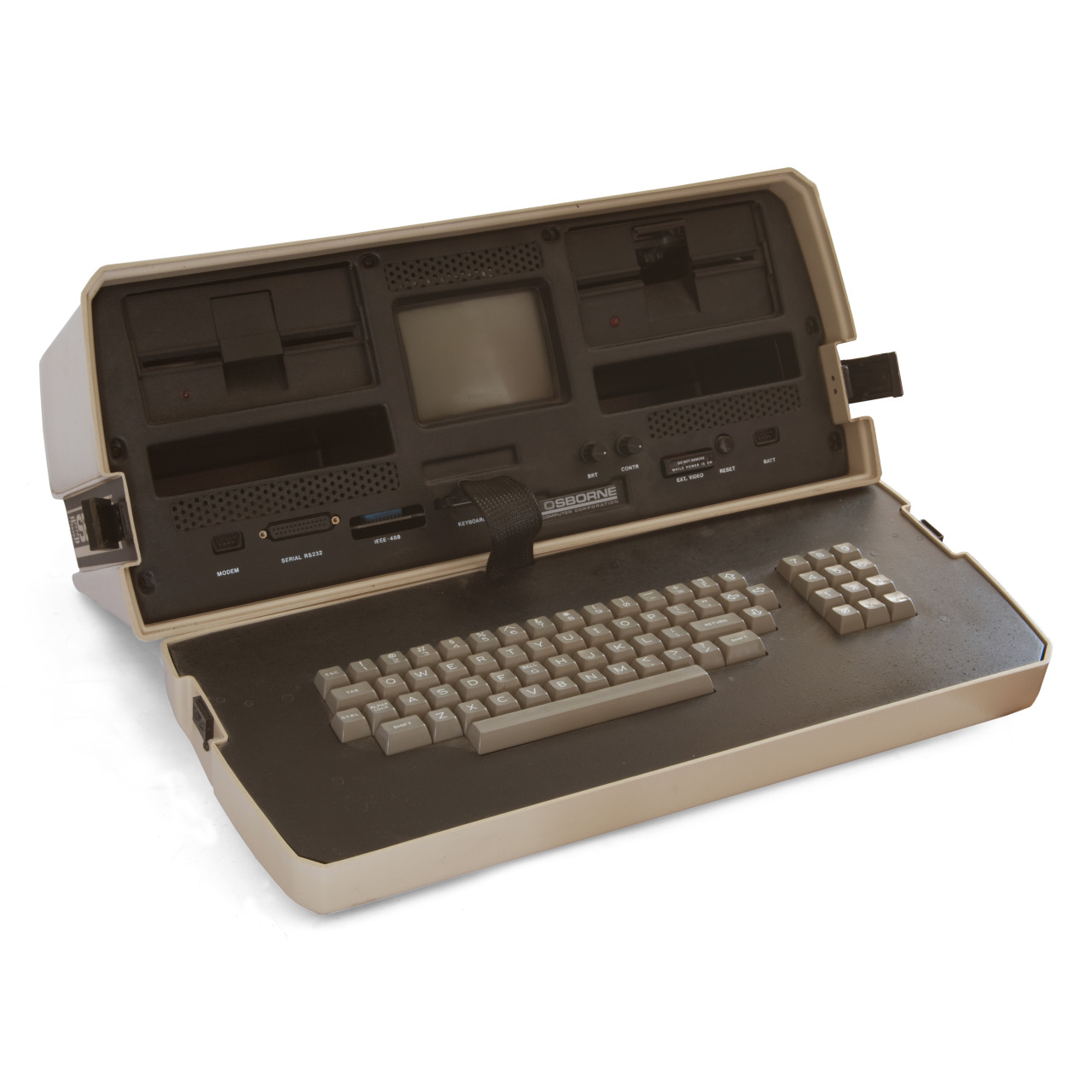
The Osborne 1, a CP/M machine that was portable, if your definition of "portable" is "a 40-pound briefcase". Its size allowed it to be stowed underneath an airline seat. It featured a 4MHz Z80 CPU, 64KB RAM, a pair of 5.25" single-sided single-density floppy drives, a full travel keyboard, and an integrated 5" monochrome CRT display that showed 52x24 character text. There was also an external video output connection for using a larger monitor. Released in 1981 for $1795, it was seen as the ultimate value package, not because of the built-in display, but because of the software bundled with it.
Back then, when you bought a computer, you got just that - the computer. Any software you wanted to use with it was a separate purchase. Heck, it wouldn't surprise me in the slightest if CP/M (the operating system) had to be purchased separately, as the computer itself would most likely only have a monitor program to bootstrap with, or a BASIC dialect if you're lucky. This made getting started with a computer very expensive, indeed.
But Osborne did something very clever. They worked with software publishers and managed to bundle many of the programs you would want to use with your new computer! This meant that you would only need to make one single purchase, and could immediately start being productive. In fact, the software alone was said to have cost $1500! And the entire computer system with software cost $1795. That is insane! As a result, the Osborne 1 was a huge hit, because it was the best possible value on the market.
However, the computer itself wasn't perfect. The 52x24 text display was very odd, compared to the more standard 80x24 displays used by other CP/M computers at the time, meaning that not all CP/M software would function correctly on the system. The display itself was also very tiny and hard to see. The drives were very sad, as they were only single-sided and single-density, which meant a maximum of 90KB per disk. And did I mention the whole thing weighed 40 POUNDS?
The drives were chosen because Adam was afraid that dual-density drives would be too fragile to be lugged around. But when it was found to not be the case, there was an upgrade made available that could be performed to replace the drives with better dual-density drives. However, that still didn't solve the other issues with the computer. For that, a new system would need to be developed. Unfortunately, Adam made a grave mistake at a press event. He was asked about these problems, and if anything was going to be done about them.
Part 3: Cultural Clash
Now, remember back to earlier in the story, where Adam was doing stuff in the Homebrew Computer Club. In groups like these, people tend to show off or brag about their projects and creations, to get feedback and show off that they're cooking up. You can see similar things now on the internet, on various communities. For example, take the ROM Hacking subforum of this very message board. Users are sharing early screenshots of their projects to drum up interest and get feedback. You see similar things on fan game community forums and Discord servers, or on art sites with people sharing WIP sketches of their newest artwork. In these environments, this is totally fine and expected, because it is peers sharing in their hobbies and interests.
The general public, on the other hand, has to be handled much differently, as what is said and shown can have intense reactions and side effects that could do the complete opposite of what you would expect from smaller communities of peers. Adam Osborne did not completely understand this, and honestly nobody else thought of this either at the time. He thought that the press could be interacted with like the chums in the Homebrew Computer Club, that they would be super excited for what was in the works.
And so he answered the question by revealing the successor machine, the Osborne Executive, far earlier than he should have to the general public.
This was such a tremendous fuckup, that the events that followed would be forever named after him.
Part 4: The Osborne Effect
Word immediately spread far and wide: Osborne Computer Company was making a new, better computer! It was going to fix all the problems with the Osborne 1!
And that's why people stopped buying the Osborne 1. Why spend your money now on the old model, when you can save your money and wait for the better one? Osborne's sales instantly tanked hard, because their only product... was the Osborne 1. And as a result of losing all income, they had to start laying off employees, notably the engineers that were working on the Osborne Executive, causing the project to be delayed, worsening the cash problems. It took until 1983 to finally release their successor system.
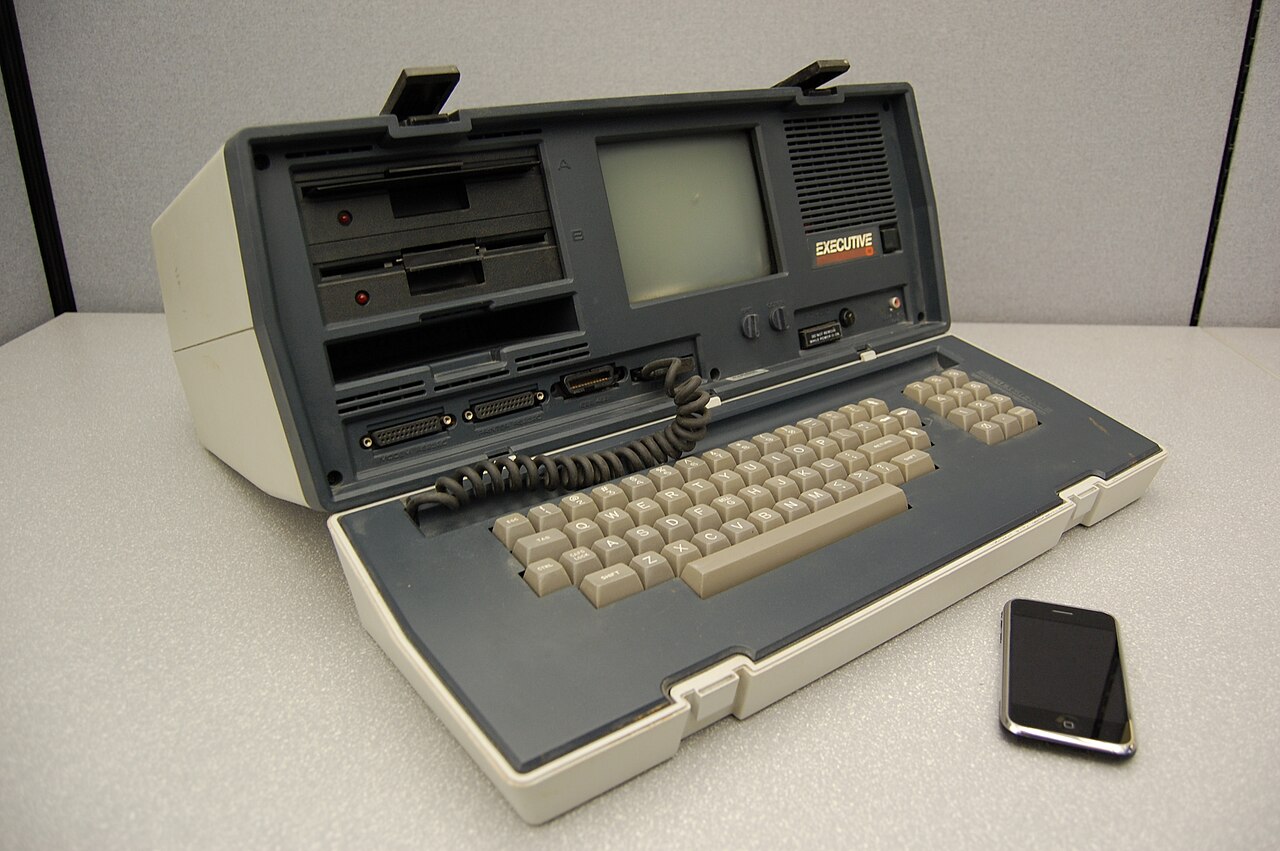
The Osborne Executive delivered on solving all of the issues with the original machine. The twin 5.25" floppy drives were now single-sided dual-density, the screen was increased to 7" with 80x24 text, the RAM was even increased to 124KB, a built-in beeper was even added, all while dropping the weight down to 28 pounds!
And nobody really bought it. Wait, why? Well, the first issue was the cost being higher than the Osborne 1, at $2495. Considering how they bled their cash reserves dry, it would make sense to try and recover financially. But that wasn't the main cause.
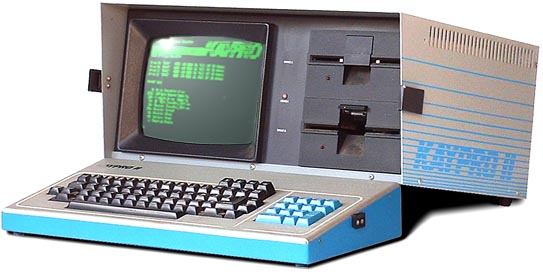
This is the main cause, the Kaypro II. Named as a subtle jab at the Osborne 1, it was released a year prior in 1982 and did pretty much everything the Osborne Executive was going to do. Despite the slower 2.5MHz Z80 CPU and sticking to 64KB RAM, it featured the same pair of 5.25" single-sided dual-density floppy drives, featured a 9" CRT with 80x24 text display, was lighter at 26 pounds (despite an all-metal case!), and did it all even cheaper than the Osborne 1 at $1595. And yes, Kaypro did work with software publishers to bundle software with the computer itself.
The competition beat Osborne Computer Corporation to the market. Kaypro knew what Osborne was planning, and released a similar product first. It's like if Nintendo had announced the Switch too early, and Valve beat them to the market with the Steam Deck.
These issues, along with insider trading-flavored management screwups, led to Osborne Computer Corporation filing for bankruptcy in 1983. It's honestly a shame to see a company get curbstomped this hard while pioneering concepts that people take for granted today. Well, guess that's that, next time we-
Part 5: The Phoenix And The Vixen
-oh wait shit we're not done? Osborne Computer Company managed to crawl out of bankruptcy??
Yes, they did manage to pull their asses out of the grave and try once more to produce a computer, as well as license a design for a second computer that... was an IBM PC compatible???
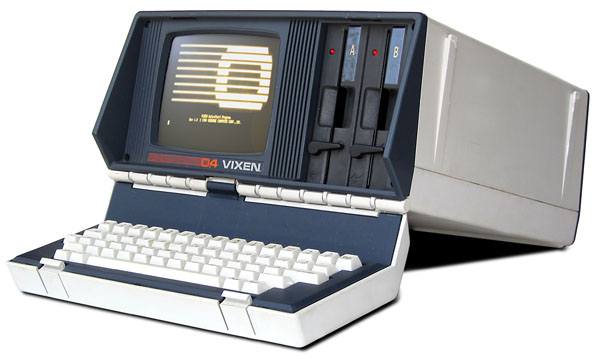
Announced in 1984 and released in early 1985, the Osborne Vixen (AKA the Osborne 4) was planned to have been released much sooner, had all of... *waves hands at Part 4* THAT not happened. The twin 5.25" floppy drives were now double-sided dual-density, RAM went back down to 64KB, given the same monitor as the Executive but in a smaller, lighter package only weighing 18 pounds, and retailed for $1298. It's a very nice setup that had one very unfortunate problem that was a result of spending time digging out of a hole...
IBM was murdering CP/M.
Yes, ol' Big Blue wanted to scorch the earth to get rid of those darn Zilog-based microcomputers, and by 1985 they had been mostly finished with the job. CP/M computer makers had to either start making IBM PC clones, or die in the fire. Even Kaypro, the company that stomped Osborne, was migrating to making IBM PC clones at this point, with their Kaypro 4+88 releasing in March, and the Kaypro 16 set to release in September of that year. Nobody wanted to be caught dead making CP/M machines anymore, so uh, uhoh.
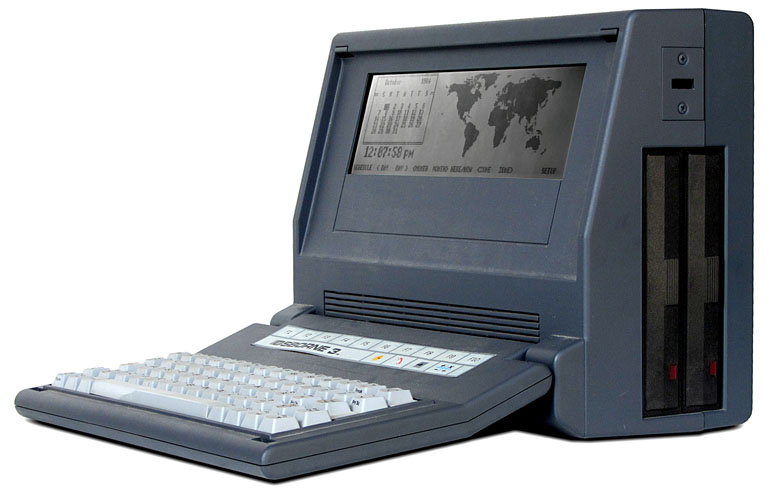
But they had something for this! Also released at the same time was the Osborne 3, a lunchbox computer that was, in fact, an IBM PC-compatible system! Powered by a 3.5MHz 80C86 CPU with 128KB RAM (upgradable to 512KB), it featured a pair of double-sided dual-density 5.25" floppy drives, a 480x128 monochrome LCD, a copy of MS-DOS 2.11, and a battery for actual portable computing! Originally retailing for $2995, it was later dropped to $1895 and given 256KB RAM as the baseline. Though, this seems very... un-Osborne like.
That's because this is actually licensed from Morrow Designs, who also sold similar systems as the Morrow Pivot. Osborne took the design and used it as the basis for a stop-gap measure. The REAL IBM PC-compatible offering was actually going to be a re-tooled version of the Vixen, replacing the CP/M guts with something more IBM PC-like. They had gotten to the point of making some working prototypes, but then they ran out of money for real this time and got sold off to pay debts.
The Osborne name was snapped up by a Finnish PC clone maker by the name of Mikrolog, and they used it for their computer lineup until 2021, when they also went bankrupt and took the name with them.
NEXT TIME ON EDUCATION YOURSELF
A shorter episode looking a bit more at Kaypro. I promised someone on Mastodon that I'd talk about a legendary disk eater...