Matra Alice: Tandy's Trash is France's Favorite
Going to be transparent and up-front about this: apparently finding English language information about something involving French nationalism is kind of hard! Who would have guessed? Anyway, today we will be discussing a computer that failed so hard, a legendary comic illustrator got commissioned to make art for it in Europe.
EDUCATION
YOURSELF
Episode 005
Part 1: Tandy Spreads Too Thin
So as we saw in the last episode, Tandy managed to get some decent success with the CoCo, and as a result became much more pleased with what Motorola was creating. However, this created some brand confusion: the original TRS-80 line of microcomputers used the Z80 CPU, and the CoCo was also called the TRS-80 but used an incompatible 6809 CPU. It was not possible to write software for both machines, and customers did have trouble finding the correct software for the computer they purchased. On top of this, Tandy didn't have anything that would help them compete with cheaper entry-level machines like the Commodore VIC-20 or the Sinclair ZX81. Surely the best solution here would be to find a way to reduce the cost of one of the existing machines and rebrand it to differenciate between the models, and not make yet another incompatible computer, right?
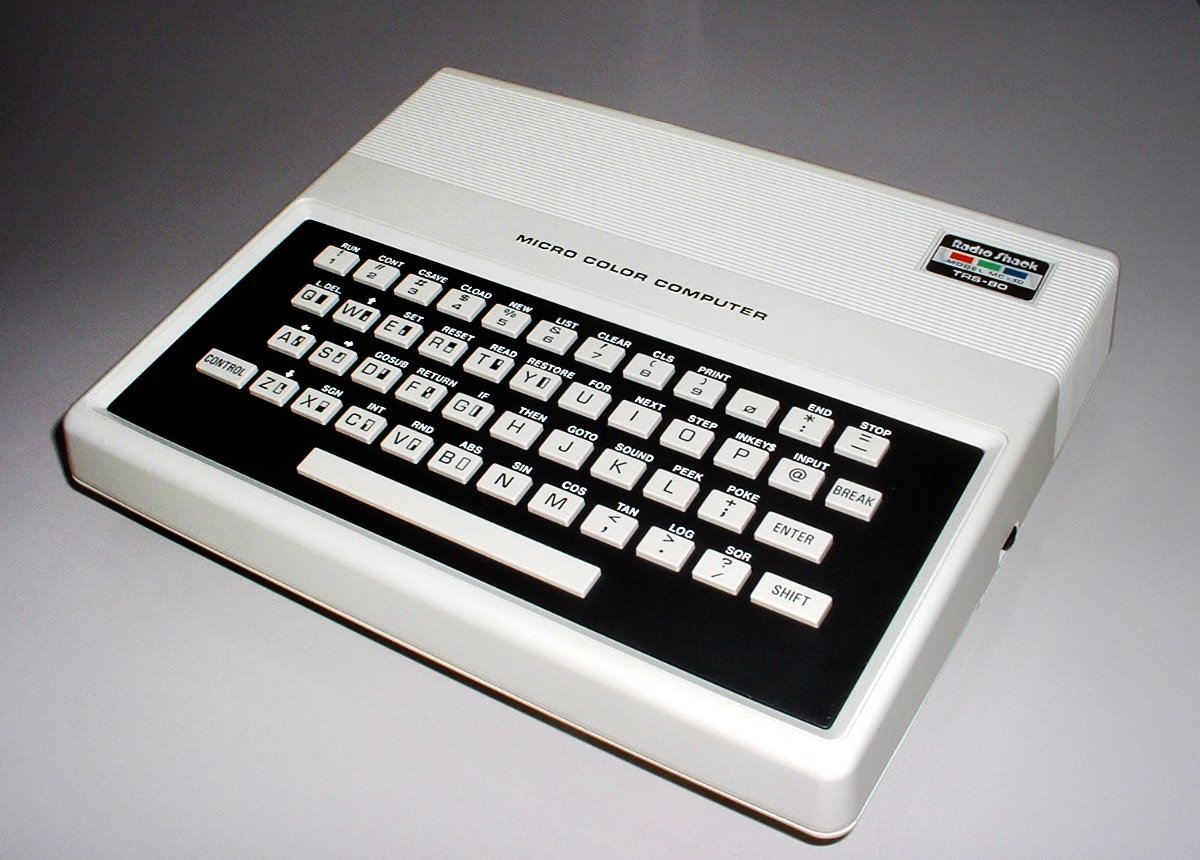
Come on, what did you think would happen? Tandy made a third, mutually-incompatible computer and called it the TRS-80 MC-10. This computer used a Motorola 6803 CPU, which was an updated 6800 with extra functions for multiplication as well as 128 bytes of on-chip RAM, but clocked at a pitiful 890 Kilohertz. While it contained the same graphical hardware as the CoCo, the CPU was incompatible with the 6809. It only had 4KB of RAM, but an external add-on could add another 16KB. A version of Microsoft BASIC was crammed into an 8KB ROM.
However, it was a complete and total mess. In 1983, a new microcomputer was expected to have things like:
- Full travel keyboards
- Disk drive support
- Medium resolution graphics
- 64K of memory
This system has a chiclet keyboard, only used cassette tapes, low resolution graphics, and barely any memory. It also has really bad RS-232 serial functionality. The 6803 CPU has a built-in UART, so it SHOULD be able to do it without needing any special hardware or hacks. But the engineers only provided one timing crystal - a 3.58 MHz TV colorburst crystal to properly generate video - which did not divide correctly for serial communication timing. Instead, all serial communications are done manually in software, which results in a very unstable and difficult-to-use connection. The MC-10 was canned in 1984, less than a year after it was released. Now, what to do with all that unused stock… Tandy looked for an unsuspecting European country to offload onto, and lo, they saw France.
Part 2: Computer Literacy But FRENCH!!!
In the early 1980s, the BBC started a project known as the BBC Computer Literacy Project. The goal was to educate the population about microcomputers and make people not have unhinged terror against the machines. This was very successful, and its flagship microcomputer - the BBC Micro, created by Acorn Computers - is a beloved system even to this day. France saw this, and believed they could do it better, on their own, and more French! This was known as the Informatique pour tous (“Information technology for everyone”) programme. But they didn't have a computer to pair it with.
In walked, of all people, Apple Computers, from the United States, trying to goad the French government into using their computers for the programme. Apple had done incredibly well in the US, providing complete computing setups for various school districts for cheap-as-free prices, with the goal of locking them into their ecosystems.[Note 1] Being able to do this on the scale of an entire Eurpoean nation was just too tempting to pass on, and so they kept pushing to be part of the programme despite one of the requirements being that the computers were to be made domestically If only there were something that could help them get the hint...
Tandy got in touch with French automotive company Matra, and agreed to sell them all remaining stock of the MC-10, all the spare parts, all the designs, and all the case molds. This let Tandy wash their hands of the failure that was the MC-10 and move on to making yet another incompatible microcomputer system that we will talk about in a future episode. Now, with the help of publishing company Hachette, the MC-10 was reworked with a French keyboard and a red case into the Alice, an affordable microcomputer aimed at the educational space. This was an excellent candidate computer for the programme, and since it was being made domestically, France was finally able to tell Apple to Get Bent.
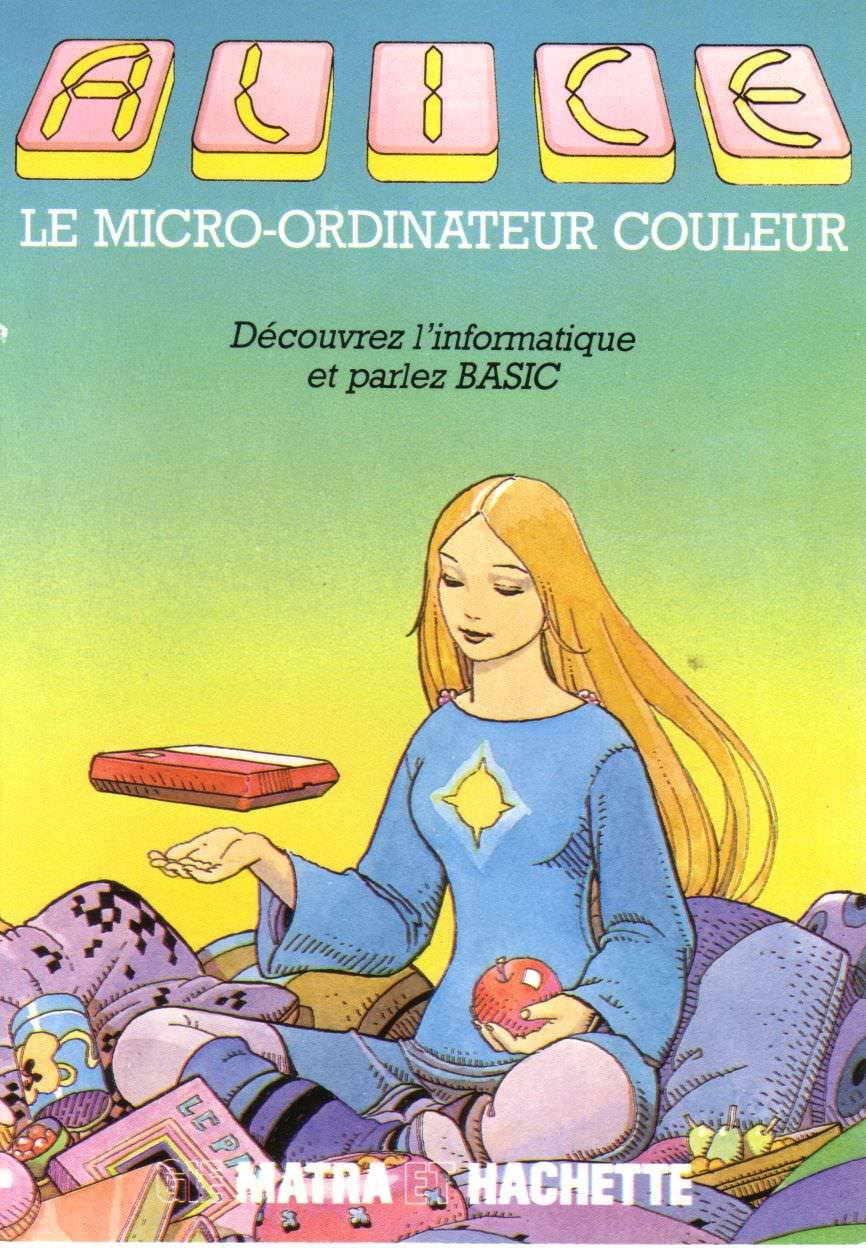
Probably the most striking feature of the rework is the presentation of the packaging and manuals. Needing something to captivate customers, Matra and Hachette commissioned Jean Giraud, a legendary illustrator better known by his pen name Moebius, responsible for the graphic novel series "The Incal" and the storyboards for "Jodorowsky's Dune". Moebius came up with the above artwork, with this example taken from the included BASIC manual, showing the titular Alice levitating the computer with magic. This automatically made the system more awesome than it should have been.
Part 3: Vying For The Goal
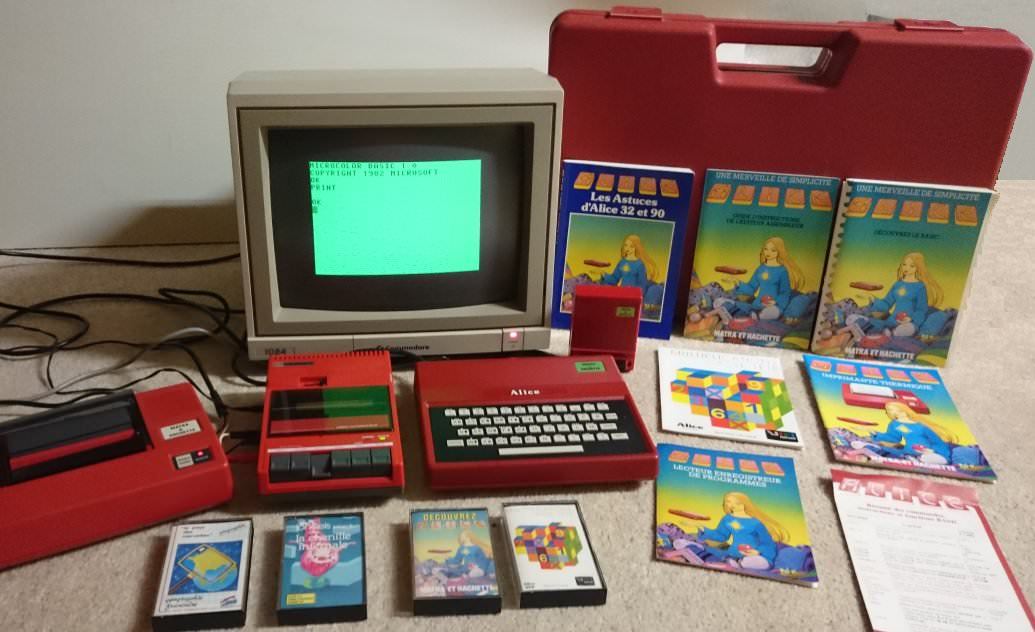
But Matra and Hachette couldn't just expect to get away with only these superficial changes. They had to fix some serious technical incompetencies with the original design if they were going to take things seriously. And so, the original Alice was quickly replaced with the Alice 32. The RAM was increased to 8KB, with an additional 8KB of dedicated video RAM, plus the ability to use the 16KB expansion module. The ROM was increased to 16KB, and featured a built-in assembler. The CPU was clocked higher to 1MHz. But most importantly, the video chip was completely replaced with the Thomson EF9345, a far more capable chip that could do 80x25 text along with semigraphics. But it still wasn't enough.
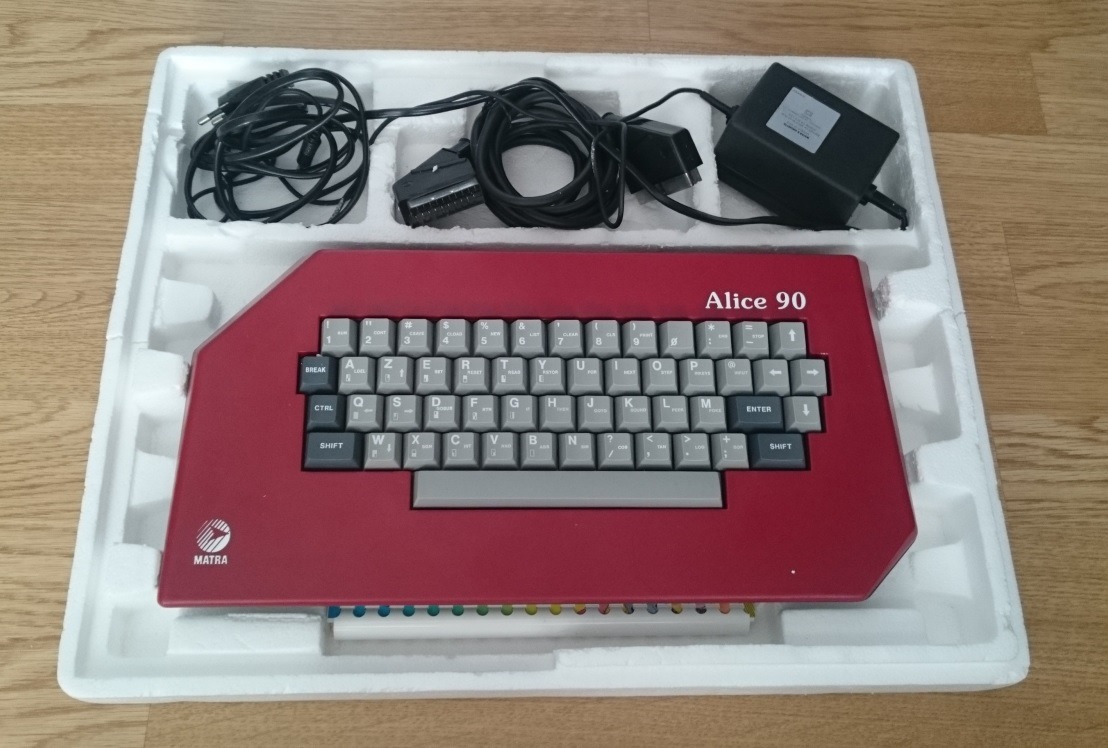
In late 1984, The Alice 90 was released. Based on the Alice 32, the RAM was massively boosted to 32KB, and the terrible chiclet keyboard was finally replaced with a proper full-travel keyboard. It was also given one very unique and amazing party trick for its time: it featured video pass-through, and allowed the user to overlay text and graphics onto video. It was a video titler! Such equipment back then was incredibly expensive, and yet here was a computer aimed at the educational market featuring its capabilities! This should have made the computer a slam dunk, giving schools an affordable means to teach video editing in the mid 80s.
And yet, despite all of this, Alice did not actually get selected for the programme. That prize instead went to the creator of the computer's video chip, Thomson, and their MO5 computer system, combined with bog-standard IBM PC clones running MS-DOS. Matra and Hachette still tried one last time with the Alice 8000, a much more powerful dual CPU design that featured a 6803 clocked at 1.2MHz and a 8088 clocked at 5MHz. It featured all the capabilities of the Alice 90, but with far more memory (64KB, up to a maximum of 256KB!) and provisions for floppy disk storage. But unfortunately, it was not enough, and the Alice disappeared shortly afterwards.
NEXT TIME ON EDUCATION YOURSELF
The crisis.
Note 1: I know about this, because my school system was one of the ones that Apple worked with, and I worked in the IT department during my high school years and as a summer job. Apple furnished the entire school system with Apple II-type systems and bought other materials like books to teach programming. In exchange, the school just kept using Apple products. I managed to get some of the older stuff during some cleaning projects, including one of the BASIC programming textbooks! It's a shame that Apple transitioned away from their products being serviceable; during my senior year we finally had stuff that none of us could actually take apart and repair, and needed to ship to Apple instead.